Showing posts with label antimicrobials. Show all posts

Thursday, December 15, 2016

An antibiotic alternative? Hope through science.

Antibiotic resistance test. Image: Dr. Graham Beards
A toddler suddenly becomes deathly ill. In the ER she is diagnosed with dysentery, caused by a rare but particularly aggressive form of Salmonella. One antibiotic after another fails because the strain, picked up when her family was traveling across parts of Asia, resists multiple antibiotics; but there is an alternative new drug. Like a guided missile, the drug targets only the disease causing Salmonella. Not only that, but as long as Salmonella remains, the drug particles replicate, increasing in number until the infection subsides. Despite the carnage, the toddler’s gut microbiome remains unharmed – no need for probiotics or fear of complications like C. diff.  If Salmonella responds by evolving resistance, the drug may respond in turn engaging an ages old evolutionary dance. By the next morning the color returns to her cheeks. By evening, she is cured.
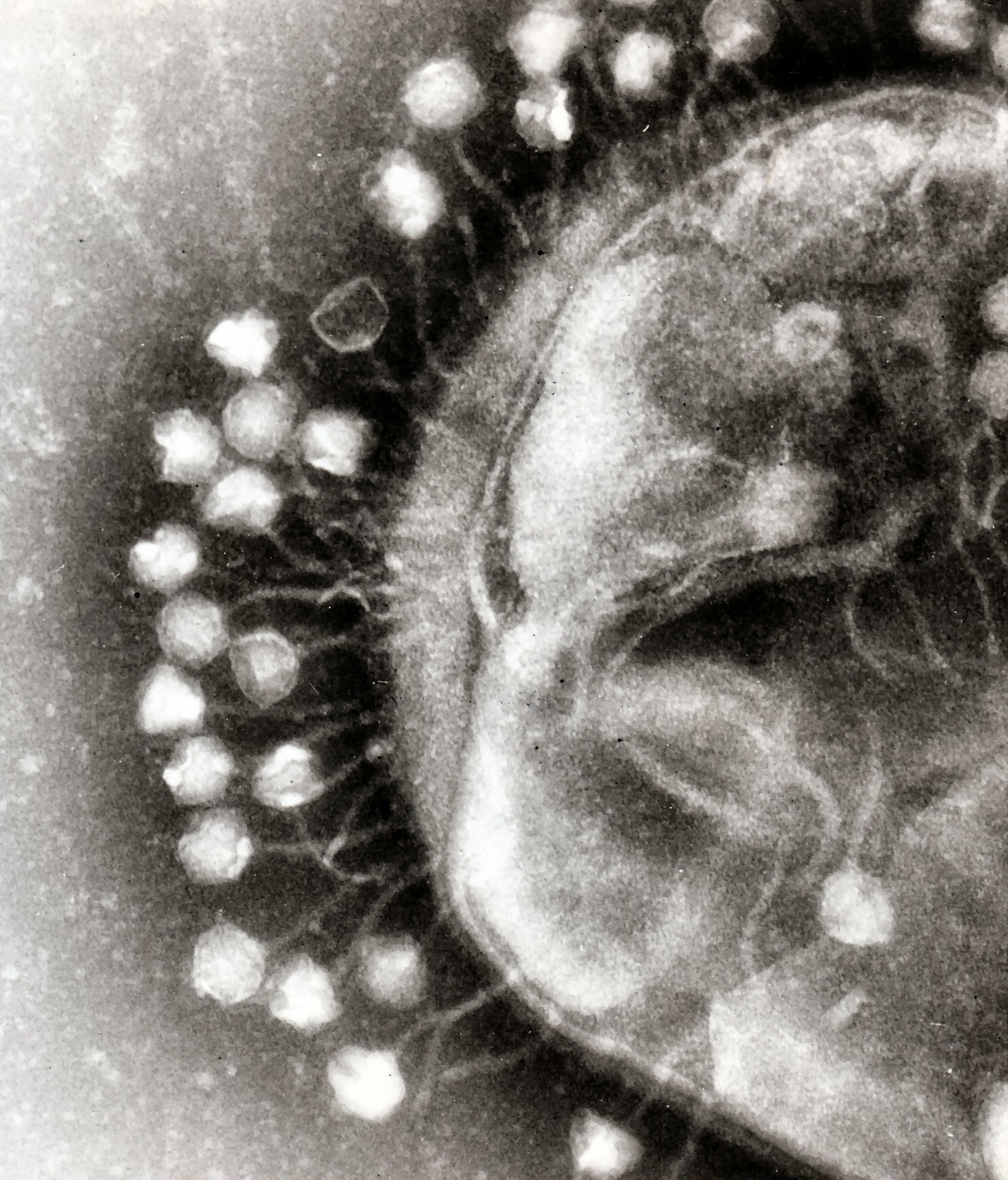
While still a fantasy here is the U.S., the scenario has been playing out in Eastern European hospitals and clinics for nearly a century. The “new” drug is a virus called a bacteriophage (or simply “phage”), that attacks bacteria. It is a cure nearly as old as life; at least as old as bacteria. Microbiologists have suggested that for every strain of bacteria on earth from the oceans to those populating our own microbiomes– there is at least one, if not multiple bacteriophages.
phage
Viral phages infecting a bacterium. Image: Dr. Graham Beards
As diseases like TB, gonorrhea, E.coli, staph and other common infections increasingly evolve to resist our antibiotics, health care workers are fast becoming desperate for new antimicrobials that are both effective and cause minimal damage to our own microbiomes. Bacteriophages are potent antimicrobials. Once disparaged here in the U.S. and in western medicine in general, these bacteria infecting viruses are making their way back into academic and biotech laboratories. If all goes well, they may be coming to a pharmacy near you.
We now know that throughout our existence viruses have woven in and out of life – leaving their stamp on most if not all living things. By some accounts up to eight percent of our genetic material came to us by way of viruses. Yet for all the fear and harm we associate with viruses many (if not most) are phages, infecting bacteria, like those in our microbiome. Genomics is just beginning to reveal the diversity and representations of these entities in nature and within our bodies. But the role that phages can serve as potent antimicrobials is no mystery. As infectious agents of bacteria they are a normal and pervasive component of earth’s flora, and they have already saved countless lives. One day they just might save us or our loved ones.
This is only one solution. There are plenty of others in the works. Lets just hope they get the funding they need in the coming years.
Adapted from  Natural Defense: enlisting bugs and germs to protect food and health (Island Press, Spring 2017.) 

Thursday, July 24, 2008

Anti antimicrobials - time to get serious about triclosan and triclocarban

I thought I was “antibacterial” savvy. For years I’ve read labels on antiperspirants and soaps before tossing them into the shopping cart. It wasn’t until I joined a consumer products working group, whose current focus is the dynamic duo of antibacterials, triclosan and triclocarbon, that I found I should also be checking my toothpaste. That’s right, listed right there on the ingredients for Colgate toothpaste was triclosan.

So why the outrage, what’s so bad about these products? Most experts including physicians groups and an FDA panel agree that these antibacterials, originally used in hospitals, aren’t really necessary for the average consumer. Unless there’s a reason to be ultra-clean, there’s nothing like a good hand washing with plain old soap.

Then there are the environmental implications of washing this stuff down the drain. As discussed a while back on this site, these chemicals tend to make their way through sewage treatment plants, persisting in soil and water. But that’s not all folks. Back when I wrote about antimicrobials I focused on the release and impact of these things into the environment. But now I read that triclosan is detectable in breast milk. And although the author concludes that concentrations are below those that might be cause for concern, here we have a chemical that 1) doesn’t seem to do much good 2) gets into the environment and stays there and 3) gets into breast milk. Hmmm.

The breast milk study, by A.D. Dayan, found “No triclosan was detected in 2 samples, it was barely detectable in 9 and the concentration ranged from about 100 to about 2100 μg/kg lipid in the other 51 milk samples.” With the majority of samples testing positive it’s curious that Dayan ponders the results, adding the following “caveats” for how and why these samples might contain the antibacterial:

"Possible contamination at the time of collection.• For example, might the mother have used a triclosan-containing soap to wash her breasts shortly before donating the milk? When did she last use a medicated deodorant, dentifrice or dusting powder?• Was the milk sample collected early or late in lactation after parturition because the body’s fat stores change with time, possibly affecting systemic exposure to any lipophilic material stored in fat?• When was the sample collected in each episode of lactation, i.e. was it ‘fore-milk’, which is more watery, or a later, hind-milk sample with a higher fat content?• Was the sample collected after a period during which the mother had not breast fed or expressed milk? Even a necessarily brief period without milk expression may make the first sample of milk then obtained more concentrated than usual.”

Skepticism is fine – what would science be without some healthy skepticism. But in this case I can’t help but be skeptical in the opposite direction – if there’s no clear benefit of the stuff – why risk exposing the most vulnerable population? Besides none of these caveats lessen the implication that breast fed infants of these women would likely be exposed at some point.

Now, a study by Bruce Hammock (from the University of California, Davis) and others, published in Environmental Health Perspectives suggest that use of these products may in fact, do more harm than good. Reporting that while triclocarban enhanced activation of steroid hormone dependent genes, triclosan was found to be antagonistic in assays designed to evaluate interaction with steroid hormone dependent activity, the authors suggest caution when it comes to triclosan and triclocarbon concluding:

“These observations have potentially significant implications with regard to human and animal health since exposure may be directly through dermal contact or indirectly through the food chain. These screening studies revealed that further investigations into the biological and toxicological effects of TCC [triclocarban], its cabanilide analogs, and TCS [triclosan] are urgently needed."

Perhaps one route, rather than relying on the consumer to read, read, read is to encourage producers to remove the stuff - or to encourage the EPA to cancel all non-medical uses - which is exactly what several environmental and public health organizations are suggesting according to an article in Water and Wastewater News.

But for now, until their campaigns are successful, it’s time to take cleanliness into our own hands and keep reading those labels.

Monday, June 02, 2008

Flush with drugs: a new database for common pharmaceuticals provides insight into surface water contaminantion

A while back I wrote about the “drugs down the drain” program, targeted primarily at those with unused drugs who might decide to tip those bottles of old aspirin, or unused antibiotics. Yes, yes, I know – there should be no such thing since we’re all told to complete the course. But – there have been times when amoxicillin just didn’t cut it. Those times when the kids’ ears still screamed with pain and a visit to the docs office leads to a mid-course correction - a stronger antibiotic– leaving a half-full bottle of the pink stuff in our fridge.

In these cases it’s important to dispose of the stuff properly – so they don’t end up medicating everything downstream. But what about the pain-killers, heart drugs, antidepressants, antibiotics, gastrointestinal aids that we (and here I’m using the royal WE) take daily? What happens to them when we, pardon the expression, pee?

According to a recent review (introducing a new database) by Emily Cooper and others, just published in Science of the Total Environment, “…between 30 and 90% of an administered dose of many pharmaceuticals ingested by humans is excreted in the urine as the active substance…” and “…up to 90% of drug residues may remain in effluent after [sewage] treatment…”

Although the fact that flushed drugs end up in local streams, rivers and estuaries isn’t new to me – these numbers are astounding. Just imagine if we could reclaim all those drugs. Why - in our school district that might just pull us out of the fiscal hell we've been experiencing for the past decade! And aside from all that waste (though it makes you wonder if pharmaceutical companies design them that way,) once they're in the water - they're no longer beneficial, but rather, environmental contaminants.

But wait – the astute reader (perhaps one of my astute students) might say. What about dose? Certainly the stuff gets diluted, certainly the local trout are not exposed to therapeutic doses of valium or Tylenol? Certainly not. But as the authors point out, several studies now show that chronic exposures to low concentrations can adversely impact aquatic organisms. And, don’t forget – that the Tylenol that I might send over to the local treatment plant will mix with my neighbor’s kid’s antibiotics, and the psychotherapeutics of another neighbor and …you get the picture. There’s a little bit of a whole lot of stuff going down all of our drains collectively.

So what to do with a problem so pervasive? Prioritize, prioritize, prioritize. Fortunately Cooper and co-authors introduce a new, fairly user-friendly database called “Pharmaceuticals in the Environment, Information for Assessing Risk” or PEIAR that will allow researchers and others to do just this.

After a quick tour, I found the site easy to navigate, and easy to track back to original sources, and full of useful information. However, since I’ve made a career of avoiding risk assessment I can’t comment on its utility to risk assessors. I’ll leave that to the pros.

Check it out at http://www.chbr.noaa.gov/peiar.

Friday, December 08, 2006

Antimicrobials: Too Much of a Good Thing?

What do my husband’s armpits, my son’s sandals, my mother’s steak knives and my daughter’s hairbrush all have in common? Antibacterials. They are all impregnated with antibacterial chemicals – well maybe not the armpits, but the underarm deodorant. These days, just about anywhere that is suitable for bacteria is apparently also suitable for antibacterial treatment by manufacturers wishing to attract health-conscious shoppers.

But here’s the rub – antibacterial chemicals are now showing up in the environment – in places they were never meant to be. In water flowing into rivers downstream from sewage treatment plants, in fish, and in treated sewage sludge that is applied to agricultural crops.

Additionally, while it’s clear that the use of antibacterials are beneficial in clinical settings, according to a Food and Drug Administration panel on Nonprescription Drugs there is little or no indication that such additives protect the consumer any better than washing with plain soap and water.

As a one-time teacher of microbiology, I’d always prided myself on having the foresight to stay away from purchasing soap products with antimicrobials. Although to my surprise, there they were in other household I’d purchased including the Teva sandals and the Old Spice Classic with triclosan that I’d bought for my husband.

“[The antibacterials] triclocarban (and triclosan) were introduced in the hay-days of chlorine chemistry, when chemicals like DDT and PCBs were considered safe. Relative to the latter, the antimicrobials are less problematic, but now that PCBs and DDT are banned, the focus has shifted to other chlorinated chemicals like triclocarban and triclosan,” says Dr. Rolf Halden, of Johns Hopkins University.

Recently, Dr. Halden’s group reported in the journal Environmental Science and Technology that the majority of triclocarban that is washed down the drain and into sewage treatment plants ends up in sewage sludge, which in turn may end up on agricultural fields.

His research reveals not only the persistent nature of the chemical (not unlike those other chlorinated chemicals now banned.) It also highlights the high volumes of these chemicals that are used by consumers and released into the environment. Halden’s group estimated that in their study area alone, more than one ton of triclocarban ends up in the environment (and on agricultural land – where it can be taken up by crops) each year!

While Halden is concerned about the release of the chemicals into the environment, Dr. Stuart Levy, the director of the Center for Adaptation Genetics and Drug Resistance at Tufts University, is concerned about the potential for antimicrobials to encourage development of antibiotic or drug resistant microbes.

Development of antibiotic resistance is an important survival mechanism for microbes, and soil microbes in particular. Soil is packed with microbes. They are part of what makes healthy soil healthy. Soil is also a fertile hunting ground for new antibiotics. In fact the first mass-produced antibiotic, penicillin was produced by a soil-dwelling microbe. What better way to stake one’s microscopic claim then to poison one’s neighbors? So soil microbes are constantly battling antibiotics produced by neighboring soil microbes. And in order to “keep up with the Jones’” or at the very least survive the Jones’ constant assaults, bacteria have become adept at developing antibiotic resistance.

The same can be said for the millions of bacteria that live on and in our bodies. When they are constantly exposed to antibiotics, it is possible that some will overcome, and develop antibiotic resistance. This is where the antimicrobials come in.

“We produced the original evidence that triclosan [a chemical simlar in structure to triclocarban] can lead to antibiotic resistance,” said Dr. Levy, “but while resistance to antibacterials has been found among bacteria outside the laboratory, they have not been linked to the use of triclosan.”

“Triclocarban is another antibacterial found in soaps. No one has looked at its mechanisms of action. There is clearly concern about the exposure to both of these antibacterials [causing antibiotic resistance], but in particular triclosan. The other antibacterials of concern are those under the heading of quaternary ammonium compounds like benzalkonium chloride. More and more data are linking resistance to this product with antibiotic resistance.”

So, antibacterials which have the potential to cause antibiotic resistance are released into the environment in huge quantities as a result of consumer use, and an FDA panel has concluded that antimicrobial products appear to be no more protective to consumers than soap and water. Who’s in charge of regulating this stuff?

Antimicrobials are regulated by both the FDA and the Environmental Protection Agency, depending upon their use, and claims made by manufacturers. EPA regulates antimicrobials when they are used as pesticides, for example to reduce odors in my son’s stinky Tevas, but FDA regulates them as drugs when used in something like the bottle of soft-soap that graces the bathroom sink at my daughter’s school. In either case – since triclosan and triclocarban were developed and registered at least thirty years ago, back when persistent chemicals weren’t known to be a problem, and antibiotic resistance hadn’t reared its ugly head – one wonders how today’s research has enlightened the regulators.

“Advances in a number of fields have changed the way we examine and interpret the potential risk of synthetic chemicals,” says Halden. “Many studies conducted in the 1970’s would not pass muster today.”

But there’s hope, according to Stuart Levy, who noted that while “there is no evidence of a change in regulation, there certainly seems to be a greater insight and concern by regulatory agencies like the FDA and EPA. They are both looking more closely at this issue, thanks to the advocacy of scientists and others.”

It’s also worth noting that perhaps not all products present the same risks. “It is presumably more likely that triclosan in a water-solubilizable form [soft-soaps for example] would be more risky than that which has been incorporated into something like a mattress or sneakers,” suggests Levy, who notes that even with these products, the fate of antibacterials is unknown.

So where does that leave us? According to Dr. Bernadette Albanese, a public health expert, “If people spent as much time washing their hands, as they do reading the labels of this stuff, we’d all be better off. Putting antibacterial in soap, towelettes, band-aids is mostly useless. The message should be proper and frequent hand washing, use plain (liquid) soap and paper towels. That is the message the public needs to hear.”

Although I’m not sure I’m ready to give up the microban treated Tevas (have you smelled a well-worn pair of Tevas?) I’ll definitely be reading my consumer products labels more carefully.